
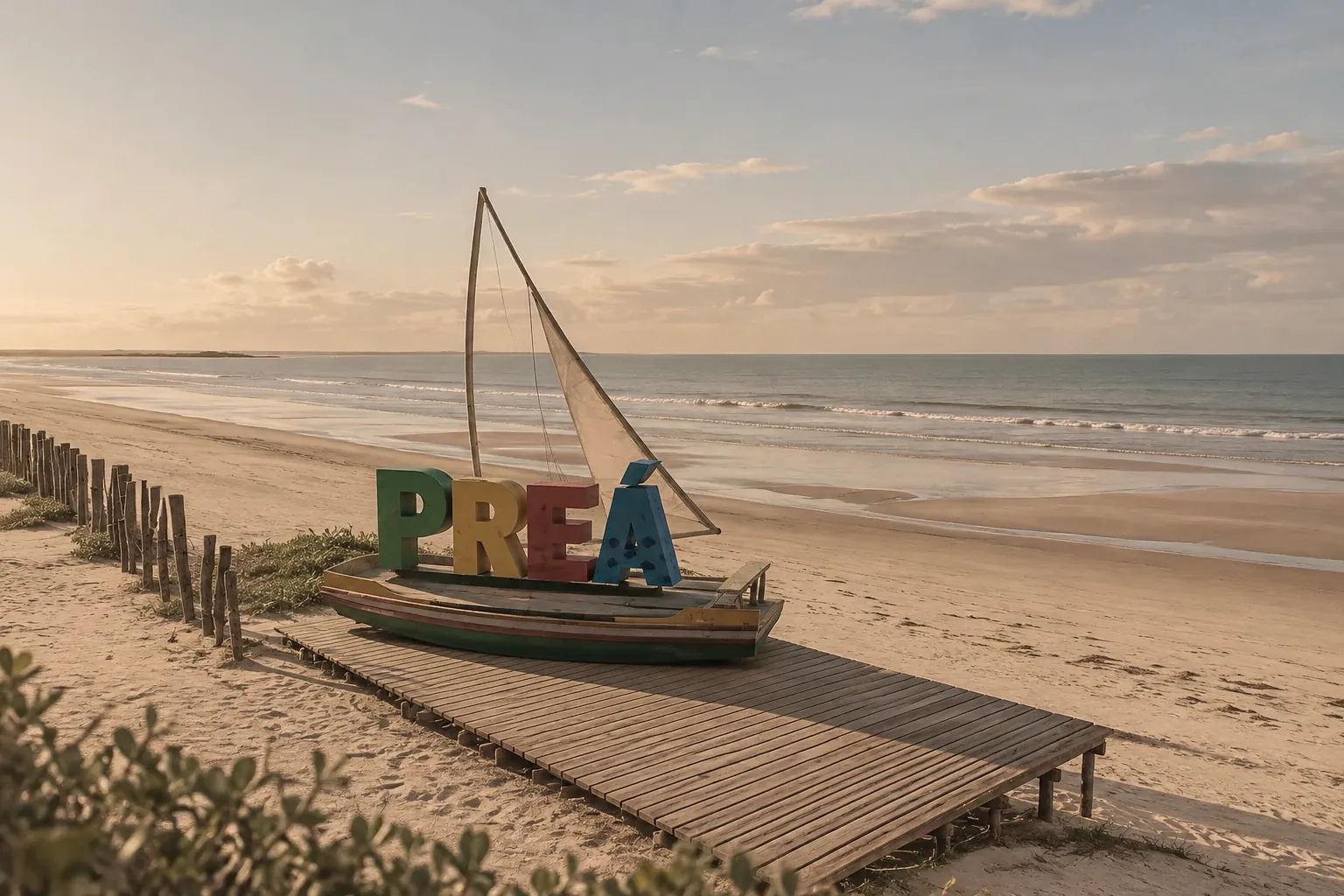
The west coast of Ceará has been going through a distinctive transformation. What was long known mainly as a fishing village and one of the world's great kitesurfing destinations has also become a place where some people begin to imagine something beyond a holiday: a second home, a new life project or even an investment opportunity.
Preá brings together qualities that help explain this movement: preserved nature, constant wind, a more private atmosphere and the gradual arrival of increasingly refined hospitality.
For anyone coming from abroad, however, there is an important difference between visiting a place and buying part of it. When a visitor becomes an owner, questions arise that rarely come up on a trip: who, legally, owns that property? What exactly is being bought? Can it be used as intended? Are there restrictions related to its location? And how does the whole process work for someone who does not live in Brazil?
A well-structured property acquisition starts with these questions.
Why is Preá attracting international buyers?
Part of the answer lies in the lifestyle the destination offers. Preá became internationally known for kitesurfing and for the natural conditions that favour the sport, but its appeal goes further. The combination of landscape, privacy, contact with nature and a less urban atmosphere also reflects a movement seen in different markets: the search for places where a property can represent not only an investment but a way of life.
The growth of boutique hotels, fine dining and services aimed at an international audience contributed to this transformation. For some buyers, this may mean a house to enjoy for a few weeks a year. For others, a property that can also be rented out when it is empty. Others still see the area as a place to develop a hospitality project or another venture.
But there is an important distinction: an attractive destination does not automatically turn any property into a good investment. The quality of an acquisition also depends on the specific location, the property chosen, maintenance costs, permitted use, demand, liquidity and, above all, the legal certainty and regularity of the asset.
Before choosing a property, define what you want to buy
Not every buyer comes to Preá for the same reason. Some are looking for a house simply to have a place of their own in Ceará. Some are thinking of a second home for the family. Some are interested in rental income, and some see an opportunity to develop a project. These goals look similar, but they lead to very different questions.
The lifestyle buyer
Looks for a personal retreat, with comfort, privacy and easy upkeep. For this buyer, the question may be: “Does this property offer the experience I want to have?”
The second-home buyer
Also thinks long term: preserving wealth, succession, maintenance costs and how easily the property can be managed from a distance.
The investor
Needs to look beyond the purchase price. Demand, occupancy, operating costs, management, taxation and liquidity become part of the equation.
The hybrid buyer
Wants to use the property for part of the year and rent it out for the rest. In this case, personal enjoyment has to be balanced with the viability of the operation.
The entrepreneur
May be looking for land for a guesthouse, a hospitality project or another venture. Additional questions of zoning, licensing and project feasibility come into play.
That is why, before asking “which property should I buy?”, there is an even more important question:
“What do I want this property to do for my wealth and for my life?”
The answer changes the search criteria.
Can foreigners buy property in Brazil?
Generally, yes. Foreigners can acquire property in Brazil, and buying an ordinary urban property does not depend on obtaining permanent residence in the country. But that does not mean every property is subject to the same rules.
One of the first things to check is the legal nature of the property. An apartment or a house in an urban area follows a different logic from the purchase of certain rural properties, which are subject to specific rules for foreign buyers. This distinction can be especially important in areas that have gone through urban expansion, such as the surroundings of Preá.
So, before moving forward with a negotiation, it is essential to confirm how the property is classified in the official registries and records. For the buyer, this is simple to grasp: before asking whether you can buy, you need to know exactly what is being bought.
What if the property is close to the sea?
Here there is a particular point that deserves special attention. A property may be advertised as beachfront, have a sea view or be a few metres from the beach. That does not mean, however, that it is subject to the same legal regime as an urban property in another part of town.
Some coastal areas fall under specific federal property regimes and may involve the Federal Property Department (Secretaria do Patrimônio da União, SPU). This is the case, for example, of certain areas classified as “terrenos de marinha” (federal coastal land) or land added to it. Depending on the situation, the private holder may be under regimes such as occupancy (ocupação) or long-term lease (aforamento), each with its own features and obligations. A transfer fee known as laudêmio may also apply to certain transfers.
The most important point, however, is not to memorise these terms. It is to understand that proximity to the sea can add a layer of analysis to the acquisition. A coastal property should therefore also be reviewed from this angle: its status with the SPU, any federal property registration, existing obligations and the documents required for the transfer.
“Sea view” is a commercial feature. The legal status of the land is another matter.
What should you check before buying?
This is where real estate due diligence comes in. The term may sound technical, but the idea is simple: investigate the property before committing a significant sum of money. In an international acquisition, this investigation should cover at least four dimensions.
1. The property
Who appears as the owner in the property registry record (matrícula)? Are there mortgages, attachments, usufructs or other encumbrances? Does the area described in the documents match what physically exists?
2. The seller
Does the person selling have the authority to carry out the transaction? Are there circumstances involving the seller that could put the acquisition at risk?
3. The land and how it can be used
Is the construction properly registered? Does the property comply with the applicable zoning rules? Are there environmental restrictions? Is there anything specific about its coastal location? And perhaps the most important question: will the buyer be able to use the property as intended?
Because buying a property legally does not necessarily mean being able to do anything with it. A house may be suitable as a residence, but not necessarily for a given commercial activity. A plot may look perfect for building, but have restrictions that completely change the feasibility of the project. A property may be close to the beach, but have legal features that need to be understood before the purchase.
4. The transaction itself
The contract, payment terms, deadlines, acquisition costs and how the transaction will be completed also need to be reviewed. Together, these checks turn a purchase based on trust into a decision based on information.
How does buying property in Brazil work?
Although every transaction has its own particulars, the process can be understood quite simply:
- Define the goal. Understand the buyer's profile, budget, purpose and investment horizon.
- Choose the property. Find a property that fits those goals.
- Carry out a preliminary review. Before going further, check whether the property deserves a deeper investigation.
- Carry out due diligence. Investigate the documents, ownership, seller, zoning, environmental status and other relevant aspects.
- Negotiate. Price, conditions, deadlines, guarantees and any necessary adjustments.
- Formalise the transaction. Prepare and sign the instrument appropriate to the deal.
- Make the payment and handle the financial steps. Including structuring the international transfer, when needed.
- Formalise and register the acquisition. With the notarial and registry acts that apply to the type of transaction.
- Organise the post-purchase. Updating records, managing the property, recurring obligations and any property management.
The key point for a foreign buyer is that signing a contract does not necessarily complete the acquisition. Property ownership in Brazil also involves an essential registration step.
What if I live outside Brazil?
This is one of the most common questions from people buying from a distance. The buyer does not necessarily need to be physically present in Brazil at every stage. Depending on how the transaction is structured, certain acts can be carried out through proper representation. This may involve:
- obtaining a CPF (Brazilian taxpayer number);
- a power of attorney;
- documents issued abroad;
- an apostille or consular legalisation, as the case may be;
- sworn translation;
- representation before notaries, registries and public bodies.
The devil is in the details. A power of attorney should not simply say that someone may “handle the purchase of the property”. The powers granted must match the acts the representative will actually need to perform. Likewise, foreign documents must be prepared according to Brazilian requirements to have effect in the country.
Buying from a distance is therefore possible under certain structures, but it should not be treated as an informal or improvised operation.
How much does it cost to buy property in Preá?
The advertised price alone never represents the cost of the acquisition. Depending on the case, the buyer should consider:
- ITBI (municipal property transfer tax);
- the deed and/or other notarial acts;
- property registration;
- any SPU-related expenses;
- professional fees;
- due diligence costs;
- banking and foreign exchange costs;
- taxes and expenses after the acquisition.
There is also an important difference between the cost of acquiring and the cost of owning. After the purchase, there may be expenses such as IPTU (municipal property tax), condominium or association fees, maintenance, property management and, depending on the legal regime of the property, specific obligations to the federal government. For those who plan to rent the property out, there are also costs and tax aspects related to running it as a business.
A proper financial analysis should therefore look at the property not only on the day of purchase, but over the whole period it will remain part of your assets.
Think about the exit before you buy
This step is often forgotten by people who buy a property out of passion. But an international buyer should also ask: what if I want to sell in a few years? How will the resale work? How liquid will this type of asset be? What costs and taxes will be involved? How will the proceeds be transferred abroad, where applicable? Will the property still suit the demand of that moment?
Thinking about the exit does not mean buying without emotion. It means turning a consumer decision into a conscious wealth decision.
Checklist: before buying a property in Preá
Before moving forward, it is worth asking a few questions:
- Who owns the property?
- Is the registry record (matrícula) in order and up to date?
- Are there encumbrances or restrictions?
- Is the construction properly registered?
- Does the area in the documents match reality?
- Is the use I intend for the property allowed?
- Are there environmental restrictions?
- Is there anything specific about the coastal location?
- What will the total acquisition costs be?
- How will the funds be sent to Brazil?
- If I am abroad, how will the transaction be handled?
- How will I manage the property after the purchase?
- What will happen if I want to sell it in the future?
If these questions do not yet have clear answers, it may be too early to sign.
The role of advisory for the international buyer
Finding a property is an important part of the acquisition. But for someone buying in another country, there is a second need: understanding what lies behind the opportunity. This is where independent advisory can help.
This work does not replace the real estate agent. On the contrary, the roles are complementary. While the agent helps find opportunities, show properties and lead the commercial negotiation, advisory focused on the buyer's interests can handle the legal and strategic analysis of the acquisition.
This may involve investigating the property and the seller, identifying risks, reviewing contracts and coordinating with other professionals when needed, such as tax specialists, accountants, foreign exchange professionals, architects, engineers or environmental consultants.
For a buyer who does not know Brazil in depth, this coordination is especially valuable. It turns a series of different documents, rules and professionals into a single view: what am I buying, what are the risks and what do I need to do to buy safely?
Preá: fall in love with the place. But buy with information.
Preá has a quality that is hard to reproduce: it has grown without completely losing the atmosphere that made so many people fall in love with it in the first place. For some, that means holidays. For others, it may mean a second home, a new project or a wealth opportunity.
But falling in love with a property is different from deciding to acquire it. An international property acquisition requires looking beyond the view, the architecture and the location. You need to understand the property, the area it sits in, the rules that apply to it and, above all, whether it truly fits the buyer's life or wealth plans.
Before buying a property in Preá, make sure you know exactly what you are acquiring.
Considering a property in Preá?
Legal advisory reviews the property, the seller and the transaction before you sign, including for buyers who live abroad.
TALK ABOUT MY PURCHASE IN PREÁ →